|
An introduction to
Australian |
|
Aboriginal art and
culture |
| |
 |
| |
| The Australian Aboriginal and Torres
Straight Islander cultures are the oldest continuous living traditions on
Earth. |
|
| At the time of British invasion in 1788,
there was an estimated population of between 750,000 and up to 3 million
indigenous people occupying every part of Australia. (The exact figure is so
dificult to estimate accurately because of the considerable number of
unreported deaths; meaning of course ‘dissapearances’, massacres and cases
of terminal illnesses due to diseases introduced by white invaders.) |
|
| Despite diverse cultures and a recorded
600 different languages, the Aboriginal peoples shared a common heritage -
refered to now as the dreamtime - and a common value system dominated by
spirituality, land and family. The dreaming tells of how, in the creation
period, the landscape was formed by ancestral beings, and how Aboriginal
peoples became human. The Dreamings gave the Aboriginal peoples the Laws by
which they should live. It gave them a strong sense of belonging to their
culture and an important sense of kinship with, and responsibility to, the
land where they lived. The dreaming holds past, present and future as one.
Perhaps a strong reason the culture has remained unchanged for so many
thousands of years. |
| |
| Estimates date Aboriginal settlement on
the Australian continent at least as far back as 50,000, perhaps even
100,000 years ago. The macropod track at Olary in South Australia has been
dated as 35,000 years old, confirming it as the oldest dated rock art
engraving site in the world. Cave paintings are believed to be much older,
but the figures can not be agreed upon. Aboriginal people themselves believe
that they have been here since the beginning of time: that is, in their
belief, the active part of creation known as the eternal Dreamtime.
|
| |
| Aboriginal society sees all things as
living and interrelated under a strong system of kinship. Responsibilities
and roles are clearly defined, and kinship incorporates everyone. An amazing
opposite to the Western system of capitalism. |
| |
| It is a culture rich with wisdom of the
natural laws of nature and humans basic existence within it. It is a culture
that holds reverence for and respect to its ancestors, which in essence
forms a strong part of the Aboriginals daily ritual. |
| |
| The Aboriginal peoples are proud of their
lineage. It is a living heritage, older than we can imagine, that has
dedicated itself to the worship and development of its spiritual beliefs.
The land can be regarded as the central cornerstone of Aboriginal
spirituality. It is the direct link between all living things and the
eternal, mythic world of the Spirit Ancestors. |
| |
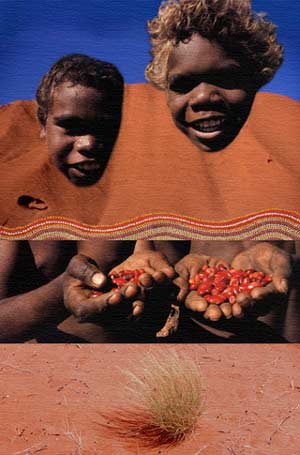
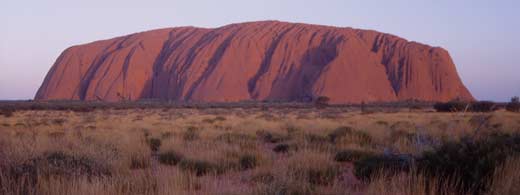
| The land is not just a surface over which
the people walk, hunt and live out their lives. The land, together with its
people, flora and fauna, and everything else it contains, is a corporate,
organic whole. The Aborigine feels part of this whole, bonded with the land
in a real dynamic identity. |
| |
|
 |
| |
| You can try to imagine the effect of
being ripped away from the land and their function with it might have had on
the Aboriginal people. A traditional Aboriginal seems completely lost in the
cities of our modern times, as it holds no relationship to the foundations
of their true identity. |
| |
| It is their exceptionally strong
relationship with the ancestral heroes and with the landscape that forms the
basis of all Aboriginal art. At the core of the arts is the Aboriginal
ceremonial life. Music, dance, song and paintings were each part of the same
process of constantly connecting the life of the people with the Dreaming. |
|
| The arts were a part of life for everyone
in traditional Aboriginal culture. Their art was expressed in the form of
decorative personal clothing, body adornment, utensils, carrying dishes,
mats, bags, nets, weapons, hunting spears and instruments, to give an
example. Every grown man and woman had a role in the making of these things. |
|
| Certain people had the duty of guarding
sacred sites, visiting and retouching art, conducting ceremonies at sacred
places or clearing the unwanted vegetation from sacred land formations.
Care-taking had strong spiritual connotations. |
|
| Intellectual life revolved around
recalling complex and extensive genealogies and ceremonial songs. The
ceremonies enacted the song cycles that described in great detail the
travels and actions of the ancestral beings, and recalling genealogical
information was a form of oral history enabling all Aboriginal people to
trace their relationship with sometimes distant tribes. The songs also
defined land ownership. |
|
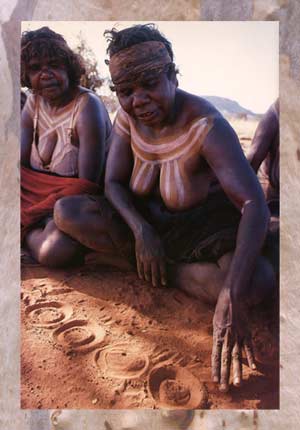
| Children were retold stories, and drawn
for in the ground. The songs they must learn contained the knowledge they
needed in society, and to continue its traditions. In these ways the
Aboriginal culture was past down the generations. |
|
|
 |
|
| Legend has it that sacred objects and
designs were either brought with the creation ancestors or made and painted
by them and taught to their descendants. Although each artist, to a degree,
brings in an individual style to his work, the symbolism is sacred to the
teachings of the Dreamings passed down the generations. |
|
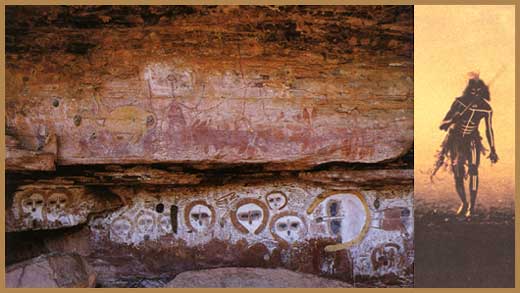
| All Aboriginal art is symbolic, and often
geometric and non-figurative. Mediums for this symbolism include body
designs, carved trees, ground drawings, rock engravings and paintings, bark
paintings, and designs on message sticks, boomerangs, digeridoos and other
sacred objects. A range of symbols are used, namely arcs, circles, dots,
bars and wavy lines. The meanings of the symbols vary in every painting
depending on the site depicted, the religious references, the degree of
information the artist has been allowed to convey (their ritual status) and
the status of the intended audience. Other tribes may guess at the symbolism
but the total meaning is only accessible to the creators and their immediate
group, those with the inside knowledge of the related mythology and
ceremonial information. |
|
| For the artists - the guardians of the
landscape or dreaming depicted - the paintings embody their own spiritual
presence. They trace the tracks and sing the songs in the process of
creating the designs. In this way reproducing the designs becomes a
religious act, a reaffirmation of belief in the creation ancestors and the
absorption of some of their essential power. The symbols are a form of
visual language in which the ancestral renewal of life is celebrated and its
continuance ensured. |
|
| In traditional Aboriginal society no man
or woman was classed as an artist. All adults were expected to remember and
to reproduce correctly the clan designs appropriate to their inheritance and
their level of ritual training and knowledge. The designs are owned by
clans, not by individuals. Every line and mark within the design has
symbolic meaning. Not only the patterns and visual symbols must be learned
precisely but also their complex and detailed meanings and the song cycles
that go with them. |
|
| Very little of Aboriginal material art
was done to last for long periods of time. It was the act of painting itself
which is important, not the finished product. Ritual items were usually
disposed of or hidden after the ceremonies they were made for were complete.
Body designs were washed away. Only the burial poles and hollow log coffins
could be seen as permanent Aboriginal sculptures and even these were left to
the elements after ceremonial use. Even the important rock paintings colours
altered with age, and eroded by weather and insect interference, and needed
constant retouching. Each painting eventually perishes, however the designs
are passed intact from generation to generation, and by constant use in
ceremony remain a continual source of strength. |
| |
|
 |
|
| In traditional Aboriginal society a
persons most important possessions are the clan’s sacred objects, designs
and knowledge of the accompanying ritual song cycles. |
|
| Aboriginal religion has permitted its
followers to live off the 'Australian' continent following its principles
for the longest span of any culture now surviving in the world. Although it
is an ancient culture, the very nature of the practice of Aboriginal art,
its role at the centre of life itself, and its multifaceted nature, allows
these ancient arts to slip easily into any modern definition of great art
and to be truly considered as treasures of Australia. Aboriginal art is a
living tradition held with great pride and love in the minds of all
Aboriginals and which should be respected and appreciated by all others. It
is a truly deep art, that we can learn a great deal from. |
|
| Art as a commercial activity has now
become fully integrated into Aboriginal social and ceremonial life.
|
|
| It is often asked whether the sale of
traditional religious art leads to its downgrading and eventual destruction.
However Aboriginal communities do not see that they are selling the designs
themselves; they are merely transposing them into forms that are portable
for Europeans and receiving some payment for sharing the designs. Just as
they would in any traditional exchange. Only general explainations are given
with the paintings and, as with amongst the Aboriginal tribes themselves,
not all designs can be shared openly. Much remains sacred to the Aboriginal
peoples. They are wise not to exploit their own essential existence,
however, at the same time, they are also concious of the awareness and
understanding of their culture their art can raise throughout the world.
|
|
| The introduction of board, canvas and
artificial materials, first introduced in the 1970's, allow the Aboriginal
artist more levage into the serious European art trade. The techniques are
more lasting, allowing the art to be considered as valuable investments in
trade. |
|
| The continuation of traditional arts in
remote communities has had an enormous effect on their pride and
self-relience. In may ways, art is the most important way in which tribal
people communicate with the wider society. When their works of painting,
sculpture, carving or weaving are appriciated, shown in galleries and bought
for high prices, the artists feel that there is a simultaneous appriciation
of their world view, their great Dreaming designs, their songs and
ceremonies. They feel heard. |
|
| The result of the recent upsurge and
increase in quality in traditional Aboriginal arts has been their acceptance
and adoption as part of the contemporary mainstream of Australian art. Not
only has this increased the status of the Aboriginal communities in the eyes
of Australian society in general, it also considerably assists in gaining
economic self-sufficiency. |
|
| There is a new growing pride in being
Aboriginal among Australians of Aboriginal descent, and a cultural revival
is taking place. Displaced Aborigines, are searching out their true identity
and relearning their customs, belief and pride of place in their culture.
Throughout tribal Australia there has been a strong resurgence of
traditional life and ceremony, and with that, a return to the land. For
example: Recent laws passed by the Federal Government have seen land
returned to the Aboriginal ownership under freehold title; in 1976, 36
percent of the Northern Territory, or 482,868 square kilometres. Small steps
in a very long but nessecary road in acheiving reconciliation and
understanding between the Native peoples of Australia and all other
Australians. Reconciliation between Aboriginal and non-Aboriginal peoples is
still an important issue for Australia. As a nation we need to reponsively
come to terms with the past as best we all can, and move forward, healed
from some of the burden of our past misendeavours and sufferings, into the
future as a just and fair, and basically united, though diverse nation. A
nation using positively the rich and varied sources of wisdon beneath its
own feet. To achieve this, we need to reaquint ourselves with all the
stories of the land. We need to understand what we have lost as well as what
we have gained in the name of 'development'. Perhaps then it may be possible
to retrieve what is needed for the land and its people to live in harmony
once again, in ways that embrace contemporary and ancient understandings.
|
|
 |
|
| From healthy roots grow strong trees.
Knowing where those roots lay and what they need for nurishment, is as
important as shining light onto the new leaves. We are, all of us, one
interlinked entity, and it is time we recognise that and behave like one! In
essence, taking a compassionate role in the whole growing, breathing
structure of our home. This begins with understanding the land and our
neighbours and recognizing them as a part of the same picture. We don't need
to adopt each others beliefs, but somehow find our common goal of existence,
and an appriciation of our differences. We can't return to what has been, we
can't change the past but we can face it, learn from our histories and work
out some positive solutions for our present steps forward. |
|
|
|
|
Text compiled from the following books: |
|
Wisdom from the Earth, Anna
Voigt & Nevill Dury, 1997 Simon & Schuster Australia, |
|
ISBN 0 7318 0569 0. |
|
Australia's Living Heritage, Jennifer Isaacs, 1984
Lansdowne Publising, |
|
ISBN 1 86302 561
|
| |
| |
|
 |
|
Click on the Aboriginal flag
to enter gallery page. |
|
|
|
|
|
 |
|
|
|
|
|
 |
|
|
|
|
|
© |
|
© 1993-2017 Moeder
de Gans - Leest u a.u.b. onze
Disclaimer,
on
line veiligheid en
Privacy beleid -
|